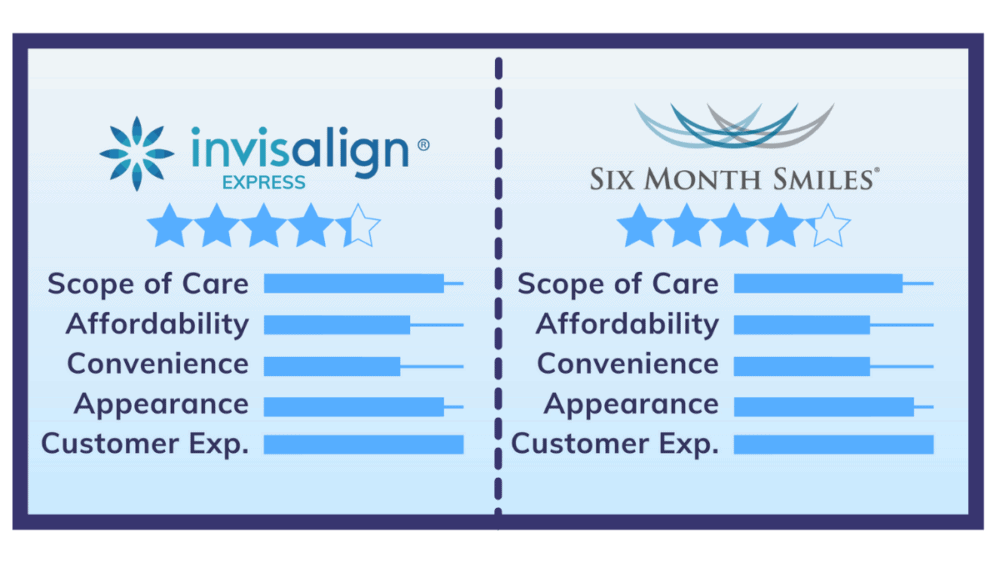
For years, orthodontic treatment was a one-track process. You went to the orthodontist for metal braces, and that was that. But after Invisalign produced the first mainstream clear aligner system in 1997, the industry evolved rapidly. New companies started finding more convenient, affordable ways to craft and use clear aligners. Of these companies, Six Month Smiles was one of the first.
Invisalign didn’t sit back and enjoy their success either. Over the past two decades, they’ve been consistently improving their clear aligner treatment and expanding the options they offer their providers. They designed Invisalign Express, to correct minor cases in just a few months. While Invisalign Express and Six Month Smiles might seem similar on the surface, they’re more different than you might think. This comparison guide covers all the most important differences between them.
Table of Contents
Company Overviews
Invisalign is an industry pioneer, the longest-standing and most widely known company in the industry. For years, they’ve delivered a highly versatile and powerful clear aligner treatment available. And in 2012, they introduced a more affordable option with Invisalign Express.
Invisalign Express treatment includes many of the same procedures as the original Invisalign, just dialed back. Your dentist will still scan your teeth and create your aligners, and you’ll still need to schedule regular office visits. But, the timeline is much shorter — typically just a few months. Just know that it’s only suitable for minor misalignments, and not every provider offers it.
Six Month Smiles is the brainchild of its CEO and founder, Dr. Ryan Swain. In the mid-2000s, Dr. Swain had patients who were seeking less-visible alternatives to traditional braces and cheaper, more convenient alternatives to Invisalign. So, he began developing his own treatment that could take the best qualities of both braces and Invisalign, and Six Month Smiles was born. Initially, Six Month Smiles only offered clear braces, but now they offer clear aligners as well.
Our Review Methodology
Smile Prep’s reviews are prepared and presented from the perspective of a well-informed consumer. Our starting point for all of our reviews is a careful survey of a company’s marketing claims and available third party customer reviews. We rely on the accuracy of company claims and do not independently verify them. Our reviews use this information to help our readers get information about the available options in a centralized location. You can learn more about our review process by checking out our publishing principles.
Scope of Treatment Comparison
One of the most pressing questions you probably have about these treatments is “do they work?” You have an ideal smile in mind, and you should be confident that your treatment provider can make it happen. The first step is determining whether they can correct your specific misalignment. Even though Invisalign Express and Six Month Smiles can’t treat severe cases like Invisalign’s full treatment, you can count on either to handle mild cases — and with Six Month Smiles, even a little more.
Invisalign Express Scope of Treatment
Six Month Smiles Scope of Treatment
- Only suitable for minor crowding and spacing in the front six teeth.
- Uses Invisalign’s proprietary SmartTrack plastic.
- Can incorporate attachments.
- Only uses either 5, 7, or 10 aligners for the entire treatment.
- Aligners are only suitable for minor cases.
- Uses dental-grade plastic from Zendura.
- Can incorporate attachments.
What Can They Treat?
Invisalign Express comes in three different packages — Express 5, Express 7, and Express 10 — each named for the number of aligners they contain. Invisalign’s Comprehensive treatment usually takes 20+ aligners, so dentists use Express for much milder cases. According to Align Technology, it’s primarily intended for:
- Relapses: This is when a patient had previous orthodontic treatment, but didn’t wear their retainer enough, causing their teeth to shift back. Typically, these misalignments are very minor.
- Anterior, Aesthetic Alignment: This means minor, cosmetic changes to the front 6–8 teeth.
Typically, this means dental gaps or crowding of 2mm or less — so it won’t work for severe cases or ones that involve a bite issue like underbite or crossbite. Ultimately, your provider will determine whether Invisalign Express is a suitable option for your case.
Six Month Smiles is similar. They say their goal is “to accomplish most, but not all, of what would be done with traditional orthodontic treatment.” The company sets their treatment window to 6–10 months, so it usually won’t work for jawbone shifts, molar movements, root repositioning, rotations, and other Class III malocclusions.
According to the company’s FAQs for clinicians, their aligners can treat:
- Crowding between 4 and 10 millimeters
- Spacing between 3 and 7 millimeters
- Mild anterior crossbites
- Posterior crossbites with favorable root positions
- Limited cases of open and deep bite, when elastics are incorporated
On their website, Six Month Smiles mentions very limited cases where their aligners can move the posterior teeth. However, they do not emphasize these cases, and some clinicians say the system can only move the frontal teeth.
Additional Attachments
One of the top advantages of traditional in-office treatments is that they allow dentists to supplement your aligners with other attachments. But because of their short treatment times and minimal office visits, Invisalign Express and Six Month Smiles don’t always incorporate the same attachments as full treatments. Fortunately, they don’t often need them, as they typically treat minor conditions anyway.
Both companies can, however, incorporate engagers. These attachments are tiny, tooth-colored shapes that help improve the aligners’ control and range of tooth movement. So while dentists typically use them for minor cases, they’re capable of more complex dental shifts — although if that’s what you need, your dentist may recommend Invisalign or another comprehensive aligner plan.
Clinical Oversight
Both companies have built a lot of dentist involvement into their treatments, giving them resources, support, and options for customization.
After your Invisalign provider scans your teeth, Invisalign’s ClinCheck software will create your treatment plan. Then, your dentist will tweak it, and they can modify it any time to better suit your needs. Many providers request office visits every 4–10 weeks so they can make sure your teeth are moving as planned, add attachments, and alter your treatment plan (if necessary). Since the timeline for Express is so short, you might end up only needing a couple of appointments.
Six Month Smiles providers typically have a similar setup. Your provider will scan your teeth, then send the scans to Six Month Smiles. If they’ve chosen to use the company’s CONFIDEX digital treatment planning (not every provider does), a team of orthodontists will digitally analyze your case and — If they feel you’re a good fit — design your treatment plan. After that, you’ll make appointments to visit the office every 4–10 weeks, depending on your case and your dentist’s preferences.
Manufacturer Quality
Invisalign’s parent company, Align Technology, is the largest and most experienced clear aligner producer in the US. They’ve been creating high-quality aligners since the 90s, and they’re always improving their products. Currently, Align Technology uses a patented material called SmartTrack for Invisalign and Invisalign Express, which the company claims moves your teeth more precisely and comfortably.
Six Month Smiles makes their own aligners using Zendura FLX plastic — from the same company Invisalign once sourced for their materials. Zendura claims their FLX material retains 50% greater force over time than other materials. One 2020 study confirms that it loses less force than certain competing plastics, but it didn’t include SmartTrack, so it’s tough to say how they compare directly.
Affordability Comparison
Most often, orthodontic treatments that require office visits and direct dentist oversight aren’t cheap. Fitting them into a tight budget might not even seem realistic.
There’s no denying that Invisalign Express and Six Month Smiles are an investment, but there are ways to make teeth straightening much more affordable. Their initial prices can be intimidating, but you’ll want to dig deeper to evaluate insurance and financing options, as they can make treatment significantly more reasonable. On average, Invisalign Express seems to be the more affordable option, but not by much.
Invisalign Express Affordability
Six Month Smiles Affordability
- No set sticker price, the average cost is $1,500–$4,000.
- Financing varies depending on the dentist, may require a credit check or down payment.
- Insurance coverage varies, depending on your case and provider.
- No set sticker price, the average cost is $3,500–$5,000.
- You can get financing through your dentist, Six Month Smiles, or a third-party company.
- Insurance coverage varies, depending on your case and provider.
Sticker Price
Sticker price is the total cost of your treatment, and it’s tough to nail down for in-office options like Invisalign Express and Six Month Smiles. The cost of these treatments depends mostly on your particular dentist and the complexity of your condition. On their FAQ page, Six Month Smiles says their average cost is $3,500–$5,000. Invisalign doesn’t give a range for their Express treatment, but based on our research, it looks like it can be anywhere between $1,500 and $4,000.
What About Insurance?
Insurance companies sometimes consider Invisalign Express and Six Month Smiles treatment “alternative” or “specialty” procedures, so they might not be as likely to cover treatment in full. Plus, if your case is relatively minor, there’s a chance that insurers might consider it cosmetic and not medically necessary. Still, if your dental insurance includes orthodontic coverage, there’s a decent chance that you’ll receive partial coverage for either treatment.
But you shouldn’t just assume! Be sure to speak with both your insurance company and your dentist’s office before diving into treatment. If you’re covered, the office will handle insurance payments and paperwork on your behalf.
Financing Options
If you don’t have a couple of thousand dollars cash in your wallet, you’re probably looking for a way to break up your payments. Fortunately, many dentist and orthodontist offices have payment plan options for Invisalign Express or Six Month Smiles.
There are also third-party companies that offer financing for orthodontic treatments, but these companies often require a credit check to qualify; so if you’re not confident with your credit score, they might not be a good option. Plus, their plans can come with high interest rates, and you’ll end up paying much more in the long run.
Convenience Comparison
It seems like life gets busier every day for adults who juggle work, family, and social responsibilities. Many industries are attempting to make their products and services more convenient, and the clear aligner industry has followed suit.
Clear aligner companies worked for years to develop easier and more accessible treatments, resulting in modified plans like Invisalign Express and Six Month Smiles. We don’t think they’re as convenient as at-home options, but with shorter treatment times and fewer office visits, each of these options presents a great alternative for busy adults seeking efficient treatment without sacrificing dentist face-time.
Invisalign Express Convenience
Six Month Smiles Convenience
- Requires an in-person consultation with a dentist to get started, including X-rays and photos.
- You’ll visit your dentist or orthodontist once every 4–10 weeks on average.
- Average treatment time is 3–6 months (six on average).
- They claim their SmartTrack plastic moves teeth more predictably than other materials.
- Requires an in-person consultation with a dentist to get started, including X-rays and photos.
- You’ll visit your dentist about once every 4–10 weeks on average.
- Average treatment time is 4–10 months.
- Uses plastic from Zendura, a widely respected manufacturer.
Startup Process
To get the ball rolling with Invisalign Express of Six Month Smiles, all you need to do is schedule a consultation with a provider to find out if the treatment is right for you. If you’re a good fit, your dentist can scan your teeth right there in the office and begin designing your aligners.
Visiting your dentist is often easier than making molds of your teeth on your own, like you’d have to for most at-home aligners. Invisalign has a lot more providers than Six Month Smiles, so it might be easier to find one. Just remember that not every Invisalign provider offers the Express option.
How Long Does Treatment Take?
Invisalign Express and Six Month Smiles focus on mild conditions that they can confidently correct within a short timeframe. Six Month Smiles isn’t shy about their treatment time — it’s right there in the name. This doesn’t mean that every single case will wrap up in exactly six months, though. According to the company’s FAQ page, treatment can take anywhere between six and ten months.
You can expect similar results from Invisalign Express. Your treatment time will depend on whether you’re using the five, seven, or ten-aligner option, but it typically ranges from three to six months, usually closer to six. During this time, you’ll need to visit your dentist around every 4–10 weeks.
Comfort & Daily Wear
Invisalign claims their SmartTrack plastic is more comfortable and moves teeth more predictably than other materials. Based on online reviews, it appears that some customers do find SmartTrack slightly more comfortable than Zendura — which Six Month Smiles uses — although it seems like both are top-quality materials.
Appearance Comparison
One of clear aligners’ best features is that they’re hardly visible. So, you can smile with confidence at work, social gatherings, and other special occasions. However, not all aligners look exactly the same.
Companies have been developing ways to make their aligners less noticeable for years, but each brand has their own ideas about what looks best. In many cases, it largely depends on each customer’s specific tastes and style. So, when considering your options, you’ll want to evaluate your own preferences.
Invisalign Express Appearance
Six Month Smiles Appearance
- Aligners use a frosted, textured plastic.
- Scallops their aligners to match your gum line.
- Attachments can increase your aligners’ visibility.
- Reasonably stain resistant.
- Aligners are fully transparent.
- Scallops their aligners to match your gum line.
- Attachments can increase your aligners’ visibility.
- Reasonably stain-resistant.
Aligner Material
We already mentioned that Invisalign Express and Six Month Smiles use different plastics in their aligners. Invisalign’s aligners are slightly frosted and textured, while Six Month Smiles says that their aligners have “exceptional clarity.”
Your teeth are naturally porous, so they have matte surfaces. In our opinion, frosted, textured aligners better match these surfaces, while smooth, transparent aligners can seem artificially shiny. But this depends on your personal preferences. Some customers report preferring shiny aligners because of the way they make their teeth gleam.
Aligner Cut
There are two methods for cutting and shaping clear aligners. The first is trimming them to match the gum line, and the second is to cut them straight across the top so that they slightly overlap the gums. Both companies scallop their aligners to match your gums, which we think can make them less visible than the alternatives.
Attachments
In certain cases, dentists might apply attachments to supplement your Invisalign Express or Six Month Smiles aligners. While these small attachments empower more complex dental shifts, they also increase visibility. Attachments are often tooth-colored, so they don’t stand out too much, but observant bystanders might still notice them.
Clear Aligners vs. Braces
As we’ve already noted, Six Month Smiles also offers braces. Braces involve brackets and wires that are affixed to your teeth, so they’re much more visible than clear aligners. But as far as braces go, we think Six Month Smiles does a good job of making them discreet. They use clear brackets and tooth-colored wires, so the hardware blends in well and is less noticeable than metal braces. Still, if appearance is one of your priorities, we’d suggest going with aligners.
Patient Experience Comparison
Straightening your teeth can be a nerve-wracking experience, especially if you choose a less traditional treatment. You might be wondering what will happen if something goes wrong, how your office visits will go, and how your dentist will ensure your results. Although the quality of care may vary, depending on the practice you choose, we think the in-person care you’ll receive during Invisalign Express or Six Month Smiles treatment is typically highly personalized and helpful.
Invisalign Express
Six Month Smiles
- Your primary point of contact is your doctor, who you should be able to reach by phone.
- Office visits are once every 4–10 weeks, on average.
- Your dentist determines satisfaction guarantees and refunds.
- Your customer service is through your doctor, who you can contact by phone.
- Office visits are around once every 4–10 weeks.
- Your dentist determines satisfaction guarantees and refunds.
Customer Service
Invisalign and Six Month Smiles each have customer care teams available by email. But with issues related to your specific case, you’ll want to contact your dentist instead. During either treatment, your primary point of contact will be your dentist or orthodontist’s office, who will field any questions that come up. They handle your treatment, billing, records, and more, so they’re knowledgeable about your case and equipped to handle any issues that might arise.
Oversight
You’ll be visiting your dentist or orthodontist once every 4–10 weeks (on average) throughout Invisalign Express or Six Month Smiles treatment. They will examine your teeth, fit you for new aligners, adjust your clear braces, and/or modify your treatment if necessary. It might be inconvenient to schedule and attend these visits, but the peace of mind that you get from regular oversight can be worth it. Plus, it allows you to ask your dentist questions and address concerns on the spot instead of going back and forth via phone or email.
Warranty & Refund Policy
Since dentists administer and monitor both treatments, the chances that you’ll end up disappointed in the results are fairly low. Even so, there’s always a possibility that you might be dissatisfied. Neither Invisalign nor Six Month Smiles have a company-wide refund policy.
If your dentist approves you for either treatment, it means that your condition is minor enough to resolve on a short timeline, so you should see the results you want. But teeth don’t always move as expected and occasionally, cases require refinements. Since Invisalign Express is a limited treatment, designing and creating additional refinement aligners may cost extra.
The Six Month Smiles “Smile Promise” says that they won’t charge you or your dentist for these additional aligners, as long as you followed your wear schedule exactly, kept good oral hygiene, and attended all the required appointments. If you did all that, you probably won’t have to pay anything more. If you didn’t, you might end up with another bill.
Which Should You Choose?
When you’re looking for a blend of efficiency and careful oversight, and your condition is relatively minor, we consider Invisalign Express and Six Month Smiles great options. We think each one can deliver quality care for certain patients. Plus, they’re both well-established and have a long history of satisfied customers.
That said, there are differences in their aligners’ materials and the procedures that make them better-suited for certain conditions. Ultimately, it comes down to your personal smile goals and priorities.
Who Should Choose Invisalign Express?
If you want trustworthy treatment from the industry’s most established brand, along with potentially shorter treatment times and lower price tags, Invisalign Express could be a great fit.
Who Should Choose Six Month Smiles?
If you want the choice between aligners and clear braces, or your condition is slightly more severe, Six Month Smiles might be worth a look.
Frequently Asked Questions
How do I get started with Invisalign Express or Six Month Smiles?
You’ll need to visit your dentist or orthodontist for a consultation. They will make impressions or take scans of your teeth to create your treatment plan and aligners. After evaluating your teeth, they can let you know whether Six Month Smiles, Invisalign Express, or another in-office treatment is the best option. Keep in mind that not all Invisalign providers offer the Express option, and your provider will decide whether you’ll get Express or Invisalign’s comprehensive treatment.
How much do Invisalign Express and Six Month Smiles cost?
Numerous factors can influence the cost of in-office treatments: your condition, the dentist’s rates, insurance, location, and more. Because these are shorter treatments, they require fewer office visits, which means lower prices. But they’re still often more expensive than home aligners.
On average, Invisalign Express costs $1,500–$4,000 and Six Month Smiles costs $3,500–$5,000. See our guides on the true cost of Invisalign Express and Six Month Smiles for details.
Which conditions can Invisalign Express and Six Month Smiles treat?
Their shorter timelines mean that Invisalign Express and Six Month Smiles usually can’t treat severe cases of crowding and spacing or bite misalignments like overbite or underbite. Instead, they’re restricted to mild and moderate cases of crowding and spacing that can be corrected in 3–10 months. However, Six Month Smiles claims their aligners can handle certain limited cases of crossbite or overbite.
What’s the difference between Invisalign Express and Six Month Smiles?
Invisalign Express is essentially a shorter version of Invisalign’s standard treatment that uses five, seven, or ten aligners rather than the usual 20+. Six Month Smiles is a similar short-term aligner plan, but they have a slightly larger scope of treatment and offer a clear braces option. Both treatments are best for people with mild cases of crowding or spacing.
What’s the difference between Invisalign Express and standard Invisalign?
While they’re created by the same overarching company, these treatments are quite different. Invisalign’s full treatment often consists of 20+ aligners and can correct severe misalignments over the course of 12–18 months. Invisalign Express, however, uses five, seven, or ten aligners to correct very mild conditions in 3–6 months. Our Invisalign vs. Invisalign Express guide has a ton more info.
How long do Invisalign Express and Six Month Smiles take?
In most cases, between three and ten months, typically around six. For any cases that will take longer, dentists and orthodontists often recommend a more robust clear aligner treatment like standard Invisalign or ClearCorrect.
How do Invisalign Express and Six Month Smiles compare to home aligner companies?
The main difference is that at-home aligner treatments don’t require any office visits. You’ll administer the treatment entirely on your own. Invisalign Express and Six Month Smiles require office visits around every 4–10 weeks so that your dentist or orthodontist can check in on your progress, employ attachments, and adjust your treatment plan (if necessary). The lack of office visits makes home aligners cheaper and faster, but it also makes them incapable of correcting certain conditions.
Which other companies should I consider?
If you’re set on traditional in-office treatment, you might want to consider ClearCorrect. It offers similarly comprehensive treatment at slightly lower prices than Invisalign. We think SureSmile and 3M Clarity Aligners are also reliable, quality treatments.
On the other hand, if you’re open to at-home clear aligners, Byte or AlignerCo are excellent options (or Candid for a hybrid at-home and in-office solution).
What is the cheapest clear aligner company?
AlignerCo. At just $995, their price beats every competitor we reviewed by a few hundred dollars, and sometimes they run promotions that drop it even lower. And if you can’t pay that up front, you can jump on a financing plan, regardless of your credit score. Check out our complete AlignerCo review for more info, or find other great-value options in our guide to the most affordable home aligners.
Does insurance cover clear aligners?
It might. Some dental insurance plans cover Invisalign the same way they would cover braces. They won’t often cover treatment if it’s considered cosmetic (like it sometimes is with both of these companies), so you’ll need to consult your specific dentist and insurance provider to find out.
Are home aligners safe?
At-home clear aligner treatment plans are always designed and/or approved by a licensed dentist or orthodontist — as long as you’re buying from a legitimate clear aligner service such as Byte.
The main concern regarding the safety of fully-remote clear aligner treatment is the lack of face-to-face care. Since you won’t be seeing a dentist in-person during treatment, you won’t receive the same level of support that you’d get with traditional in-office aligners like Invisalign or ClearCorrect. That said, a recent NIH-funded survey found the majority of at-home aligner customers were satisfied with their results, and only 6.6% experienced side effects necessitating a visit to their local dentist.
Read our guide to safe home teeth straightening treatment for more information.
Do clear aligners hurt?
When you switch to a new aligner set every two weeks, you might experience some discomfort for the first day or two, but after that, you’ll hardly notice them.
Join The Discussion: